Education in Africa

Freya Kendall has written this account of her work placement in Tanzania working with Raleigh International.

 What do you remember from your primary school years? Practising the shape of ‘a’s over and over in your exercise book? Being read exciting stories out of colourful books by the teacher? Maybe chanting your times tables over and over again until the point where you drive your parents mad? Perhaps taking home models and artwork you created from various yogurt pots and egg boxes? These are all happy memories that we take for granted in this country, but it wasn’t until I spent 10 weeks living and working out in rural Tanzania that I came to understand that many children in Tanzania, and Africa generally, do not obtain a decent primary school education due to such a huge lack of basic resources and materials.

During the summer of 2013, I was sent out to rural Tanzania for 10 weeks to work on behalf of Raleigh International and the International Citizen Service (ICS) to work on a number of different projects to ultimately cultivate development and progression of the Millennium Development Goals (MDGs) set up by the UN in 2000. One such goal is to have implemented universal primary education across the world by 2015. Sadly, I don’t think this goal will be achieved in time, not only because there is still a great deal of work for the UN and various charities and NGOs to do, but because existing schools are struggling to properly educate their children because they have very few resources to do so.

The pre-school children of Mgongo Primary School, with Freya (behind the boy in the Gap t-shirt)

I visited and taught at various primary schools within a 20 kilometre radius of where my team and I were living, and at each primary school we frequently came across the same problem: the teachers struggle to teach the children as there simply are not enough decent resources to go around. Classes of 40, 50 or even over 60 children with one teacher would sometimes have only four or five battered old textbooks to work from. Many of the children did not have proper exercise books, as these are not given out by the school, but rather have to be paid for by the family. As a result of this, high numbers of children did not have an exercise book because their family simply could not afford one. Many of the children did not have a pen or a pencil of their own, and virtually all the textbooks I came across (though it has to be said that there were not many) were extremely outdated and not appropriate for primary school curriculum.

How can children be expected to learn the most basic maths and literacy skills if such basic resources cannot be provided? How can we look to implement universal primary school education across the world if the existing schools are not able to educate their children properly? We all seem to agree that it is education which is the key to breaking the poverty cycle, so we must work to provide schools with the most basic of materials to allow the teachers there to give the children the best possible education.

What I am urging is for people to have a look in the loft, in the old bookshelf which houses all manner of books no one ever looks at, and give whatever books and resources they can to the wonderful charities that can take donations and distribute them to schools across Africa. It may not seem like much to send a few books across, but I know first-hand that any donations will be highly appreciated and could change the lives of children, families and generations to come.

Here are just a few charities which gratefully accept book and monetary donations:

Books for Africa

Books to Africa

Book Aid for Africa


If you’re interested in hearing more about what I, my team or other teams have got up to out in Tanzania, here is a link to the weekly blogs we wrote whilst we were out there.

To learn more about the life changing work that Raleigh International do or the International Citizen Service, please visit Raleigh International or International Citizen Service.

For more detailed information of the Millennium Development Goals, please visit the website.

 

Protect you home and vehicle(s) from theft

The Earlsdon Neighbourhood Police Force would like to remind ECHO readers about the importance of protecting homes and vehicles from theft. PCSO Richard Brown explains why.

 I can confirm that, in January this year there were nine reported home burglaries and 13 counts of vehicle damage or theft. For the majority of the burglaries, entry was gained by forcing/smashing a rear window or door and stealing small electrical devices (laptops, phones etc.) Three of the 13 reports regarding vehicles were thefts of number plates. The others were all regarding theft from cars with three having had windows or doors forced and seven having been broken into with no damage caused. The root cause of the break-ins appeared to be leaving sat navs, cash and handbags on display.

Please help us by reporting any suspicious behaviour or crimes as they happen. We have had reports from residents that there is someone trying to break into cars in the early hours so please remember not to leave items in your vehicles overnight. If you spot anything, please pass the information on.

You can also help to protect yourself and your property by following these simple guidelines:

  • Always lock all doors and all accessible windows
  • Use a timer switch to turn lights and radios on when you are out or away to give the impression that your house is occupied
  • Close curtains and blinds after dark so that your valuables can’t be seen from outside
  • Install a visible burglar alarm and make sure you turn it on. If it has ‘zones’, turn on the alarm for downstairs while you are upstairs, asleep
  • Register your valuables for free on the national property registration site so that if your property is lost or stolen and recovered by police, you’re more likely to get it back
  • Do not leave tools (or anything that might assist a burglar) out in your garden
  • Lock your car and check who if there is anyone around when you walk away
  • If you have a garage then use it for your car

As always, the Earlsdon Neighbourhood Police Force is available to carry out surveys of premises so we can assist in making your home or vehicle a harder target to burgle.

We also hold monthly police surgery meetings at the War Memorial Park, Earlsdon Methodist Church and Earlsdon Library.  All dates and times are on local boards and the website (below). These are in place so that you can come and speak to us in person about any concerns you may have.

Contact the team:

For an emergency – 999

For non-emergency – 101

Earlsdon Police website

Earlsdon Police Twitter

West Midlands Police website

West Midlands Police Facebook page

Crimestoppers – 0800 555 111


New and Views from Canley Ford

This time last year we were still in the icy grip of winter, but this year, the middle of February, it’s still raining.  We are very lucky to avoid the serious flooding of buildings but everywhere is waterlogged and every stream and river full to the brim.

However the rain has also brought us many beautiful rainbows, some of them have been double. Secondary rainbows are caused by a double reflection of sunlight inside the raindrops, and appear at an angle of 50-53⁰.  As a result of the second reflection, the colours of a secondary rainbow are inverted compared to the primary bow, with blue on the outside and red on the inside.

The secondary rainbow is fainter than the primary because more light escapes from two reflections compared to one and because the rainbow itself is spread over a greater area of the sky.  The dark area of unlit sky lying between the primary and secondary bows is called Alexander’s band after Alexander of Aphrodisias who first described it around 200 AD.  Rainbows have a rich and long history; some cultures view rainbows as omens and others see them as lucky.

Fungus
One of the interesting fungi to be found even at this time of year

There is always something to see at Canley Ford, even in the rain.  Our snowdrops are at their best now.  Snowdrops are some of the first bulbs of the year to bloom.  This early flowering, which carpets the ground between January and April, is aided by hardened leaf tips that can push through frozen earth.

The downside to flowering in winter is that pollinating insects are scarce, so these little drops of snow spread mainly through bulb division.  The flower is milky white as indicated by its scientific name Galanthus, from two Greek words meaning ‘milk’ and ‘flower’.  There are green markings on the inner petals, which experts are able to use as a means of identification.  These are said to glow in ultraviolet light and thus attract pollinators such as bumble bees to whom ultra violet light is visible.  Once the temperature reaches 10⁰C, the outer petals open to be horizontal, thus attracting pollinating insects.

“The snowdrop in purest white arrair,

First rears her hedde on Canalemas daie.”

From an early church calendar of English flowers c.1500. 

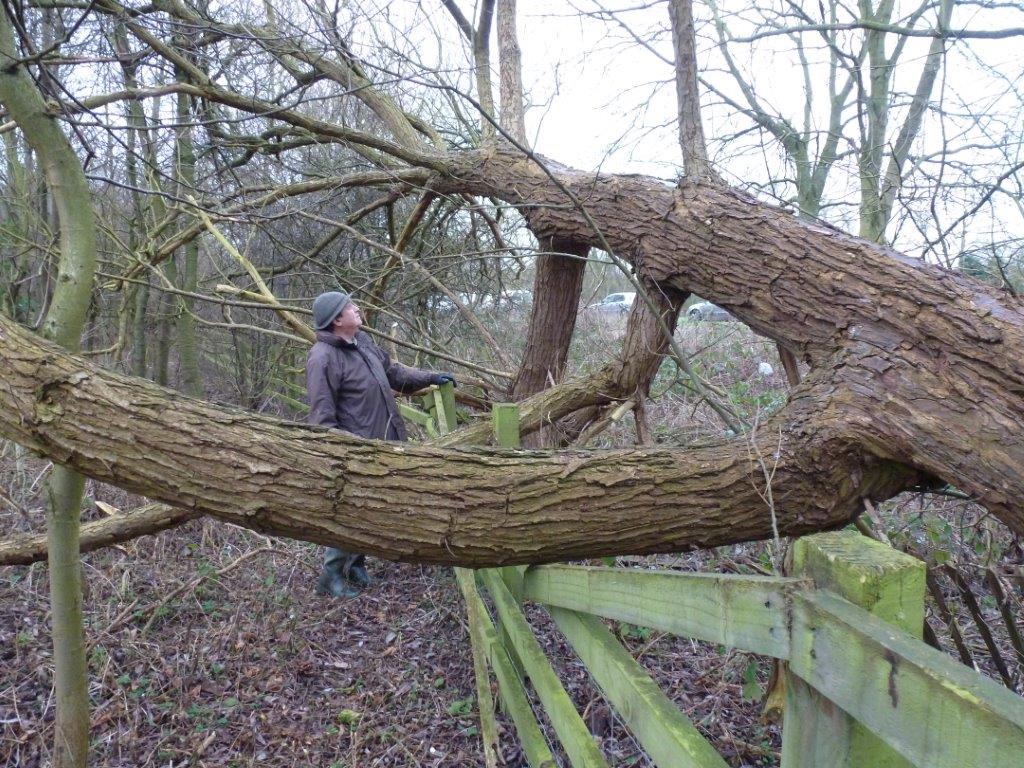
Oh dear! More fence mending needed

Enjoy your walk at Canley Ford, we saw two mice in the leaf litter gathering berries for their food store, there are still crab apples under the leaves for hungry squirrels.  We also saw some colourful fungi and celandine in flower.  The next working party will be on Saturday 1 March 10am till 12 noon with coffee and biscuits at 12, everyone is welcome.

FRIENDS OF CANLEY FORD


Cartoonist Nick

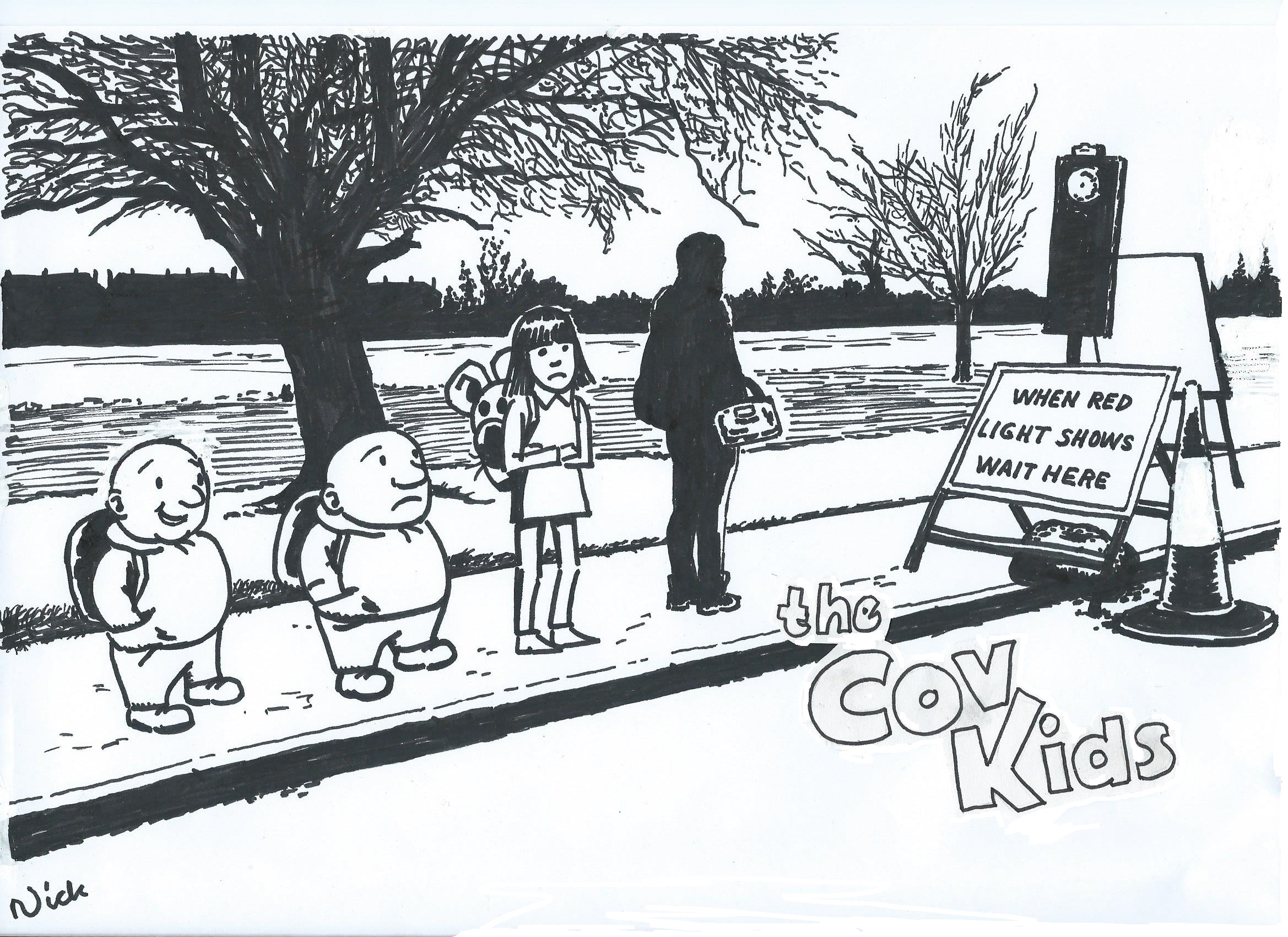
A familiar background and a reference to current traffic problems, captured by Nick's pen
A familiar background and a reference to current traffic problems, captured by Nick’s pen

Earlsdon based cartoonist Nick Shingler has been featured regularly in the Coventry Telegraph recently after the Telegraph invited cartoonists to submit their work to be considered for publication. Nick’s creation the Cov Kids has proved popular with readers.

Nick, who moved to this area from Wolverhampton in the 1980s, is a building surveyor by profession, and has recently been elected a Fellow of the Chartered Association of Building Engineers, but has been drawing and painting all his life.

After winning a children’s art competition when he was a teenager Nick had a painting featured in a London gallery, which led to national coverage in the Guardian newspaper, and in the 1980s had paintings exhibited in Coventry Cathedral and the Herbert. Drawing cartoons has also been a long term hobby and he particularly admires the work of the hugely popular British cartoonist (Carl) Giles of the Daily Express and the American Jack Kirby from Marvel Comics.

At the Leeds Thought Bubble Festival a few years ago Nick exhibited a full comic strip of an airborne Angel of the North and has supplied a cartoon for the Sky Blues Trust but the nine cartoons that have appeared in the Coventry Telegraph are his first such work published in a newspaper. The Coventry Music Museum charity admired his 2-Tone cartoon and requested he donated a signed copy which Nick was happy to do.

Nick draws using traditional pen and ink, creating an A4 image which is then reproduced at one third the size. He uses recognisable and realistic backgrounds, including some clearly identifiable in the ECHO area, and then puts his Cov Kids characters into those scenes. The drawing process itself takes 2 to 3 hours but extra time is required in preparation, seeking suitable backgrounds and taking photos that he can work from later.

Nick lives in Earlsdon with his wife Nicky (“Yes, it does cause confusion”, he says) who used to teach at Earlsdon Primary School and now gives private tuition in English and maths, and their sons Ben, 19, and Joe, 17.


Pirouettes and prairies

There’s an interesting variety of shows coming up at the Albany Theatre, with ballet, musicals and even psychology! Dance company Ballet Theatre UK visits on 13 March, with the world premiere of their production of Hans Christian Andersen’s popular story ‘The Little Mermaid’.  The ballet explores the nature of longing, the lasting consequences of making choices and how goodness can be rewarded in unexpected ways.  In the story, the mermaid of the title rescues a human prince during a storm and falls in love with him.  She strikes a bargain with an evil sea witch that allows her to follow him onto dry land but it carries a heavy price.  The Albany Theatre performance is the first show of an extensive spring tour of the UK and Ireland that takes in more than 60 venues.

Richard Wiseman
Richard Wiseman

Best selling author, psychologist and magician Richard Wiseman brings ‘An Evening of Psychobabble’ to the theatre on 18 March.  The show premiered at 2012’s Edinburgh Fringe Festival to sellout audiences and rave reviews, with one critic describing it as “hard to beat”.  Richard promises to rummage around in your mind with games, fun and entertainment exploring the psychology of luck, dreaming and how to change your life in less than a minute.  He holds Britain’s only Professorship in the Public Understanding of Psychology, at the University of Hertfordshire and has spoken at The Royal Society, The Royal Institution and has addressed organisations such as Microsoft, Google and Amazon.  Richard has also acted as a creative consultant to Derren Brown, the MythBusters, and Heston Blumenthal.

‘Another Opening, Another Show!’ on 22 March sees talented young performers from both the Jill Purser Theatre School and Earlsdon Ballet School display their talents in a showcase of song and dance, covering an array of styles including ballet, musicals, tap, freestyle and more. Moving into next month, The Guildhall returns to the theatre between 2 and 5 April with an ambitious production of musical favourite ‘Calamity Jane’, which includes a stage coach in its set.  The show’s story is based on the life of American frontierswoman Martha Jane Canary, who was best known for her association with Wild Bill Hickok and gained her nickname during the 1870s.  The stage musical is based on the 1953 film starring Howard Keel and Doris Day and includes all of the well known songs, including The Deadwood Stage (Whip-Crack-Away!), The Black Hills of Dakota and the Academy Award winning My Secret Love.

Tickets for all shows can be bought in person from the box office, by phone (7699 8964) or via the theatre’s website.


A madhouse at the Criterion

The warning signs were there: the blood-spattered programme, with its ‘parental advisory’; the menacing stewards; the panic alarm on the desk.  But that was scant preparation for what followed.  Anthony Horowitz’s Mindgame, the latest Criterion Theatre production, was a visceral examination of good, evil, psychiatry, and the boundaries between sanity and madness.

Hack writer Styler (played by the increasingly bewildered Jon Styles) makes a living penning popular accounts of serial killers’ crimes.  The play opens with his arrival at Fairfields mental hospital to interview convicted killer Easterman.  But in this hermetically sealed world, nothing is quite what it seems, and events spiral out of control from the word go.

His host, Craig Shelton’s disquieting Dr. Farquhar, seems strangely unaware of the writer’s supposedly pre-announced visit.  When Farquhar persuades Styler to don a straitjacket to ‘get inside the mind’ of Easterman, all hell breaks loose.  Farquhar morphs into Easterman, at the head of a mob (unseen) that has apparently taken over the institution and killed the real Farquhar.  Murder and mayhem then seemingly ensue, with Styler in the end persuaded that he is in essence no different from the serial killer who fascinates him.

Is Styler really a mad inmate all along, caught up in an elaborate psychodrama?  We’re never told.  The three actors did a superb job of creating and sustaining a bewildering, intimidating, even frightening atmosphere, throwing out questions about who and what is normal, the malleability of personality, and the imbalance of power in institutional relationships.

The central stage, with audience seating on three sides, allows the audience to get uncomfortably close to some apparently pretty stomach-churning action.  Suffocation, death by scalpel (with appropriate noises off) – the advisory about onstage smoking seemed likely to be the least of a parent’s worries.  But Anne-marie Greene’s taut direction steered the piece expertly away from the reefs of schlock horror on which it could easily have been wrecked, and allowed the actors to demonstrate, once again, just why an evening at the Criterion is such a compelling event.

The production for March is the “warm, tender – and multi-award winning” play, Brian Friel’s Dancing at Lughnasa. The piece premiered at Dublin’s Abbey Theatre in 1990, and tells the story of five impoverished spinster sisters in a remote part of County Donegal at harvest time in 1936.

The five Mundy sisters, ranging in age from twenty-six to forty, live in a cottage outside the village of Ballybeg, and are barely able to make ends meet.  With them live Michael, seven year old son of the youngest sister, and Jack, the sisters’ elder brother, a missionary priest newly returned from Africa.  The events of that summer are recounted looking back by the adult Michael, who reminisces with warmth and tenderness about that time.

Previous productions of the play elsewhere have won many awards, including an Olivier and a Tony.  It’s also been made into a film starring Meryl Streep.  This production is directed by the Criterion’s Annie Woodward, and runs from 22 to 29 March.

Tickets are available from the box office – for details of how to book using the secure voicemail/online ticketing, visit the Criterion website or you can phone the box office on 024 7667 5175 (evenings from 8 – 9 pm the week before the play is on, or 7.30 – 9 pm during the week of the play).


Schools news

HEARSALL PRIMARY

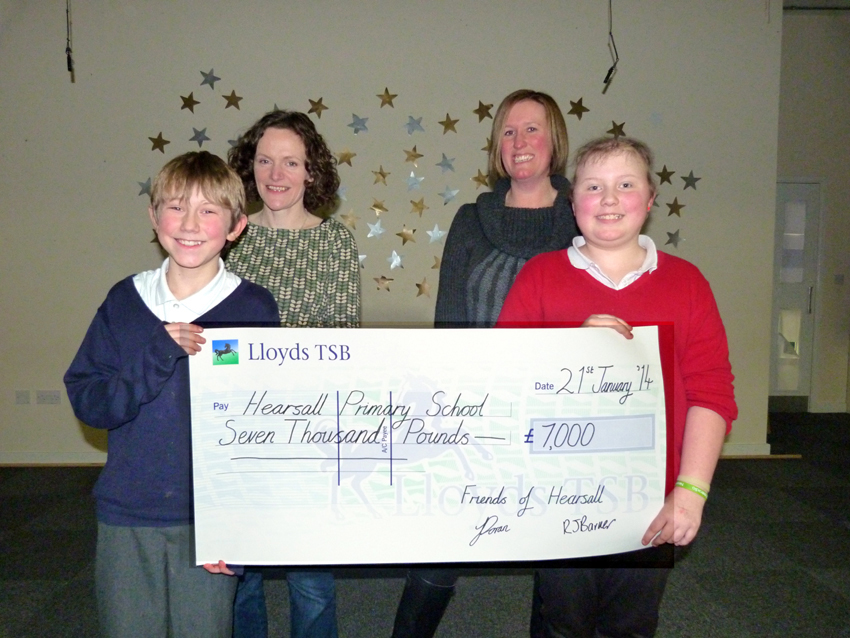
cheque presentationHearsall Primary School’s Parent Teacher Association were delighted to be able to present a giant cheque to the Headteacher, Mrs Emma Billington, recently (pictured, right).  The cheque, for £7000, was presented by Chair of the Friends of Hearsall, Rachel Barker along with some pupils from the school, in a Friday afternoon assembly.  The money will be used by the school to purchase some much-needed IT equipment, from which all of the school’s pupils will benefit.

Friends of Hearsall have been working hard over the last school year to raise this money.  They have held many successful events such as the hugely popular Pamper Evening in June (watch this space for information about the next one, so that you do not miss out!) as well as the school’s traditional Christmas and Summer Fayres.  Parent helpers have turned out in all weathers to run after school Cake Sales, including twice in the snow, and in the summer term Friday afternoons were often celebrated with an Ice Cream Sale in the playground.

“We have a great team running events” says Rachel, “but it is really the parents of the school who make what we do a success.  Without their support we could not have raised this sum of money.” Mrs Billington, Head Teacher at Hearsall added, “our children are extremely excited about the new equipment and it will be an enormous enhancement to their learning experience.  We are very thankful to our parents and carers”.

Friends of Hearsall’s next big purchase will be outdoor play equipment for the playground.


WI open meeting

Yes ‘open meeting’ means non-members and even men are welcome too! This month’s meeting takes place at 7.30pm on Thursday 13 March at St. Barbara’s Church Hall.

This will be an opportunity to meet Joe Elliott MBE (pictured, right). Joe is a well known Coventry businessman, Chair of Trustees at the Coventry Transport Museum and founder director of Culture Coventry, running the city museums. He is former life president of Coventry City Football Club.

Joe will also be highlighting the work of the NSPCC Business Board raising money for projects in Coventry and Warwickshire.

The cost of entry is £5, including refreshments and you can pay on the door.


Teen romance gets steamy


Off the back of the commercial success of her debut novel “Wicked Games”, Earlsdon based author Kelly Lawrence has launched a new novel.  Set in Coventry and aimed at older teenagers, “Unconditional” is the story of  Ashley, an A grade college student who falls in love with a boy from the “wrong side of town”.  Fresh out of prison, Joe is out of bounds but Ashley can’t seem to keep away. He’s the one that she wants, and she wants him to be her ‘first’…but at what cost? Unconditional is on sale now.


Private libraries galore

Last month we printed a letter from Mrs A D Atkin of Armorial Road enquiring about the privately owned lending library which used to be on Earlsdon Avenue North from the 1950s to the 1970s.  We have had several responses about that and similar libraries in the area.

Mrs Brannigan wrote to say that her friend remembers the small library on Earlsdon Avenue as she worked there as a part time assistant.  She says “It was run by a lady called Mrs Wise from the front room of her house and it was especially busy on a Saturday afternoon”.  Elaine Parnell confirmed that there was a library on Earlsdon Avenue just past Kensington Road, on the right going towards Hearsall Common and David Lloyd sent us a photo of what he thought were the premises, although this was not the case.

Colin Armstrong, who ran Armstrong’s Books and Collectables in Albany Road from 1983 to 2007, tells us he didn’t remember the library himself but sent a copy of a book jacket from ‘Hearsall Library’.  This establishes the address as 200 Earlsdon Avenue, with opening hours of 2.30pm to 7pm Mondays and Wednesdays, 2.30pm to 8pm on Tuesdays and Fridays and 10.30am to 1pm and 2.15pm to 8pm on Saturdays – no less than 28.5 hours in all!  The library claimed to stock ‘all the latest Fiction: Westerns, Romance, Mystery, War, General, Science Fiction and Period’.  The book jacket also advertised several nearby businesses: June Evans, hairdressers at 169, grocer J Wheatley at 123 Earlsdon Avenue and P A Shore’s betting shop at 5 Coniston Road (now a barbers).

It seems that there were other private libraries in the area.  Mrs Brannigan told us that there was a small library in Melbourne Road and Elaine Parnell gave details of one in Albany Road, known as the Sweet Library because it was part of a sweet shop.  It was on the opposite side of the entry where Statham’s Flowers is now and is believed to have been run by sisters.

ECHO would like to thank all those who helped provide information – and we would welcome more, particularly details of the years that the libraries operated.